Login / Register

Verify OTP

Update Profile

Top Carbide Insert Brands Compared: Sandvik, Kennametal, Mitsubishi, and More
Compare top carbide insert brands like Sandvik, Kennametal, Mitsubishi, and more. Learn ISO nomenclature, coatings, chipbreakers, and applications in CNC machining.
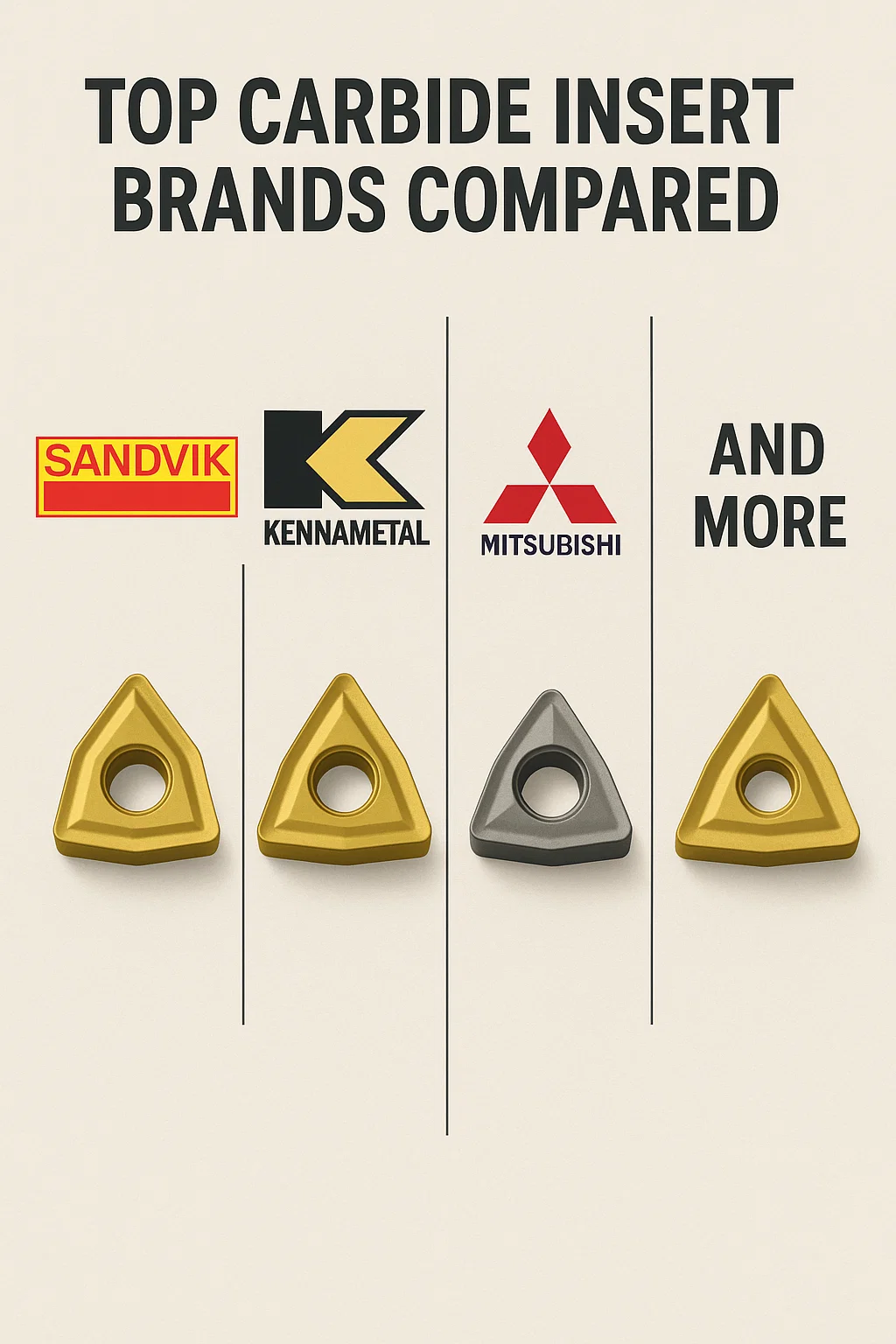
Carbide inserts are the backbone of modern CNC machining, ensuring precision, productivity, and cost efficiency. But with so many leading brands — Sandvik, Kennametal, Mitsubishi, ISCAR, Widia, and others — choosing the right insert can feel overwhelming. This guide compares the top carbide insert brands, explains ISO 1832 insert nomenclature (like CNMG 120408), and breaks down coatings, chipbreakers, and grade selection in plain language. Whether you’re machining steel, stainless, cast iron, or superalloys, discover how to match insert geometry and grade to your application. Explore practical use cases across automotive, aerospace, die & mold, and general machining — and see why CNC Tools Depot is the world’s most trusted source for carbide inserts.
Why this topic matters
Carbide inserts are the replaceable “business end” of modern CNC cutting tools. They determine productivity, surface finish, cycle time, and cost per part in high-volume and precision machining. Picking the right insert geometry, chipbreaker and grade can double tool life or eliminate chatter, while a poor choice can blow up cycle time and scrap rates. Major brands — Sandvik, Kennametal, Mitsubishi, ISCAR, Widia and others — provide the geometries and grades used across automotive, aerospace, die & mold, and general manufacturing.
What an indexable carbide insert is
An indexable insert is a small, hardened cutting tip (usually tungsten carbide with a binder) manufactured to precise dimensions and sold with a coded designation. Inserts are clamped into a holder; when an edge wears, the insert is rotated (“indexed”) to a fresh edge or replaced. This reduces setup time and overall tooling cost compared with brazed or solid-carbide tooling.
How to read an insert code (step-by-step)
The international standard ISO 1832 defines the designation (the code) for indexable inserts. The standard sets the positions and meaning of symbols used in codes such as CNMG 120408-MP. Use the ISO system like a compact spec sheet: each character or number tells you geometry, relief/clearance, tolerance, size and more.
How the ISO code is structured (compulsory positions 1–7):
-
Shape (letter) — e.g., C = 80° rhombic, S = square, T = triangle, R = round.
-
Normal clearance / relief angle (letter) — e.g., N = 0°, C = 7°, P = 11°.
-
Tolerance class (letter) — geometric tolerances for d (inscribed circle), s (thickness), m.
-
Fixing / chipbreaker / special features (letter) — often used by manufacturers to indicate chipbreaker style or clamping.
-
Insert size (numeric code) — relates to cutting edge length / inscribed circle.
-
Insert thickness (numeric code) — s value (codes map to mm/inches per ISO tables).
-
Corner configuration / nose radius (numeric) — e.g., 08 = 0.8 mm.
(Positions 8–9 are optional for edge condition and cutting direction; ISO includes more symbols for tipped/PCD/CBN inserts.)
Example — decode CNMG 120408-MP (step by step)
- C: 80° rhombic insert shape.
- N: 0° clearance (negative geometry).
- M: tolerance/style code (manufacturer + ISO tolerance class).
- G (or the next letter in some examples): indicates ground cutting edges or a specific cross-section/chipbreaker family (manufacturer may append).
- 12: insert size (IC ≈ 12.7 mm / 0.5").
- 04: thickness code (ISO code 04 → s ≈ 4.76 mm).
- 08: nose radius code → r ≈ 0.8 mm.
Manufacturers publish datasheets that match ISO symbols to their physical part drawings — e.g., Mitsubishi, Sandvik and Widia show CNMG120408 dimensions and intended applications.
(Analogy for beginners: read an ISO insert code like a product SKU that tells you “shape, how sharp it is, how thick, and how rough/fine the corner is” — equal to a recipe that tells a chef what size pan, how hot, and how long to cook.)
Key technical features
Shape & included angle (why it matters)
Shape (C, D, S, T, R, etc.) defines the included angle of the cutting edge. A round (R) insert is strong and good for heavy interrupted cuts; a small included angle (e.g., triangle T = 60°) gives sharper corners for tight profiles but is less robust. ISO tables list included angles for each shape.
Clearance / relief angle (N, C, P…)
The clearance (sometimes called side relief) controls how the tool clears the workpiece as it cuts. N = 0° is negative geometry (stronger edge for heavy cuts). Positive clearances (e.g., C = 7°, P = 11°) reduce rubbing and are used for finishing and softer materials. Pick negative geometry for heavy roughing, positive for finishing or soft/ductile materials.
Tolerance class
Tolerance class (ISO symbol in pos. 3) sets allowable dimensional variations for d (inscribed circle), s (thickness) and m. Higher accuracy (tighter tolerance) matters for tooling fixtures or when wiper edges are present.
Chipbreaker and cutting edge form
Chipbreakers control how the chip curls and evacuates. A good chipbreaker reduces long stringy chips, improves surface finish and reduces cutting forces. Manufacturers design families of chip-forming geometries tuned for finishing, medium, roughing, or heat-resistant alloys. (When you see an extra suffix like -MP5 or -LC, that often shows chipbreaker family and feed/ap band.)
Coatings & grades — PVD vs CVD vs uncoated
- CVD (Chemical Vapor Deposition): applied at higher temps, builds thicker/alumina-rich layers (good high-temperature wear resistance). Often used for tough steel/cast-iron operations.
- PVD (Physical Vapor Deposition): thinner, smoother, applied at lower temps; preserves sharp edges and resists chipping — excellent for stainless steel and finishing.
Manufacturers combine substrate microstructure + coating to create grades aimed at ISO material groups (P=steel, M=stainless, K=cast iron, N=non-ferrous, S=superalloys, H=hardened). See Sandvik and Kennametal grade guides for mapping grades to material groups.
Edge prep and corner radius (r)
A larger corner radius improves strength and surface finish for roughing; a smaller radius lets you cut tighter features and achieve finer finishes. Match nose radius to required surface finish and minimum feature size.
Choose right insert
- Identify workpiece material (ISO group P/M/K/N/S/H). (This is step #1 for grade selection.)
- Decide operation: roughing, semi-finishing, finishing. Choose a chipbreaker family (roughers have deep chip formers, finishers have sharp edges / wipers).
- Select geometry (shape, clearance): negative for heavy cuts, positive for finishing. Consider tool path and access geometry.
- Pick grade/coating that matches material and cutting condition (wet/dry, interrupted/continuous). Use manufacturer grade charts (Sandvik, Kennametal, Mitsubishi) as cross-reference.
- Choose size and corner radius to meet stiffness/feature requirements (bigger = stiffer & stronger).
- Test & tune: start with conservative parameters from the supplier data sheet and increase speed/feed until stable; monitor flank wear to optimize cost per part. Manufacturer datasheets provide recommended cutting windows.
Brand comparison
Sandvik Coromant — wide grade portfolio, strong R&D & machining guidance
- Sandvik maintains broad grade families (CVD & PVD) for steel, stainless, cast iron and exotic alloys and publishes in-depth grade/geometry guidance. Their resources and application data make them a go-to for aerospace and demanding steel machining.
Kennametal — broad industrial coverage, strong grade & coating tech
- Kennametal publishes detailed grade & coating technology guides (KENGold / KENGold CVD, PVD etc.) and conversion tools. Known for solutions across turning, milling and tough materials. Good for shops that value grade-to-process conversions and industrial support.
Mitsubishi Materials (Mitsubishi Carbide) — global ISO insert lines and localized datasheets
- Mitsubishi offers wide ISO insert ranges (CNMG, TNMG, etc.) with datasheets and tooling sheets showing recommended parameters — a staple in many Asian and global machine shops.
ISCAR (IMC Group) — innovative geometries and strong grade mapping
- ISCAR (part of IMC) publishes compact grade tables and is known for innovative chipbreakers and application-specific tooling systems used heavily in automotive and die/mold industries.
Widia / Walter / TaeguTec (and others) — competitive, system offerings
- Other full-line suppliers (Widia, Walter, TaeguTec, Seco, Kyocera, Sumitomo) offer complementary advantages: specialty grades, regional support, and holder systems. Use OEM datasheets to compare performance vs price.
Practical industry
- Automotive: high volumes, mix of steels & castings — robust negative geometries and CVD-coated grades for roughing, PVD for finishing.
- Aerospace: titanium & nickel alloys — choose grades formulated for heat resistance and chip control; specialized CBN/PCD or ceramic solutions for some components.
- Die & mold: die steels and high-finish surfaces — sharp edges, PVD/Multi-layer coatings and small radii/wipers for mirror finishes.
- General machining / job shops: balanced cost/performance — versatile grades and economy insert families from Kennametal, Mitsubishi and others.
Frequently Asked Questions
Read CNMG piece by piece: C = 80° rhombic shape; N = 0° clearance (negative); M = tolerance/series code; G (or next letter) often indicates ground edge or chipbreaker family; following numbers (e.g., 120408) give size, thickness and nose radius. Manufacturer datasheets (Mitsubishi, Widia, Walter) show the exact metric values.
Stainless steel often needs PVD-coated grades with strong edge stability (to resist built-up edge). Brands publish stainless-specific grades — check Sandvik and Kennametal grade charts and start with the manufacturer’s recommended feeds/speeds for stainless.
Use ISO 1832: positions 1–7 are mandatory (shape, clearance, tolerance, fixing/chipbreaker, size, thickness, corner). Example and full decoding are available in the ISO standard and manufacturer guides (Walter, Kennametal).
CVD is deposited at higher temperatures and forms thicker, more heat-resistant layers (good for high wear and heavy cuts). PVD is thinner and applied at lower temps — it preserves sharpness and resists chipping, often preferred for stainless and finishing. Use manufacturer grade guidance for exact recommendations.
CNC Tools Depot specializes in stocking a wide range of ISO-coded inserts from leading brands (Sandvik, Kennametal, Mitsubishi, ISCAR, Widia, etc.) and can help you filter by ISO code, chipbreaker family and grade — streamlining the selection process for your shop. (Explore the marketplace to view datasheets and compare part numbers.)

India's Largest Marketplace for Carbide Inserts & Cutting Tools.


© 2026. All Rights Reserved
Disclaimer: All Brand Logos belong to their respective owners, CNC Tools Depot is sharing publicly available information