Login / Register

Verify OTP

Update Profile

Proper Storage and Handling of Carbide Inserts
Learn best practices for the proper storage and handling of carbide inserts to maximize tool life, maintain ISO 1832 standards, and ensure consistent machining performance.
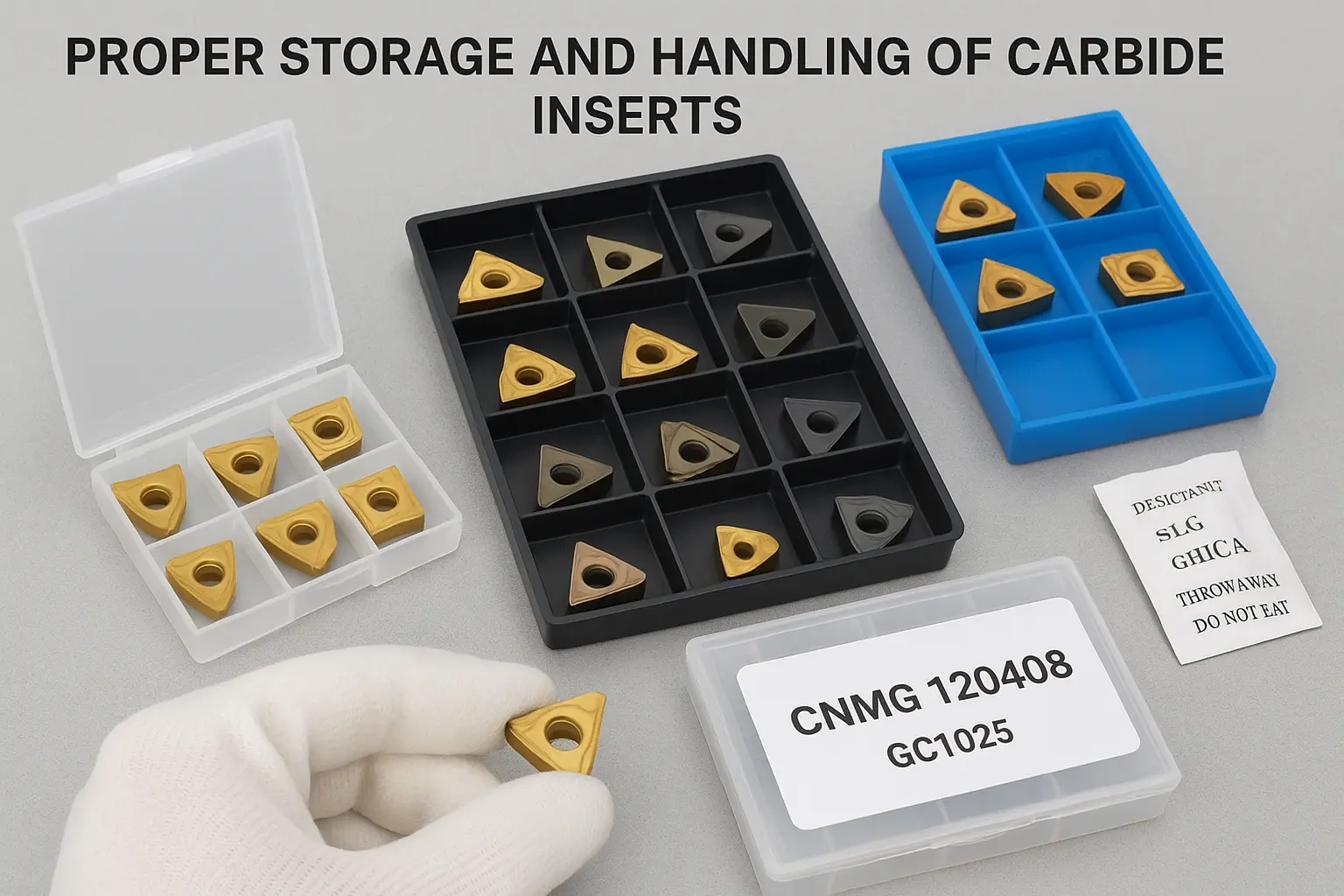
Proper storage and handling of carbide inserts are critical to achieving consistent performance and reducing tooling costs in CNC machining. Carbide inserts, whether for turning, milling, or drilling, are precision-engineered cutting tools with coatings and geometries designed for specific materials and applications. Incorrect storage—such as exposing them to moisture, dust, or edge contact—can lead to micro-chipping, coating damage, and reduced tool life. Following ISO 1832 nomenclature ensures correct identification and sorting, while using compartmentalized trays, desiccants, clear labeling, and careful handling with clean gloves protects inserts from contamination and physical damage. Industries such as automotive, aerospace, die & mold, and general machining benefit from disciplined storage systems that maintain traceability and prevent costly downtime. CNC Tools Depot recommends these best practices to help manufacturers maximize productivity, safeguard investments, and keep carbide inserts performing at their peak.
ISO 1832 — a quick primer (how to read insert codes)
Indexable insert designations follow ISO 1832 (turning/milling inserts). The ISO code is intentionally compact: the first 4 characters describe the design group (outline, relief/clearance, tolerance class, configuration), and the next 3 pairs (or digits) describe dimensions (size, thickness, corner radius).
ISO positions (simple)
- 1 — Shape (letter): e.g., C = 80° rhombic (diamond), T = 60° triangle, S = 90° square, R = round.
- 2 — Clearance (relief) angle (letter): N = 0° (negative), C = 7°, P = 11°, etc. (Positive vs negative affects edge strength and ability to enter tight bores).
- 3 — Tolerance class (letter): e.g., M (molded/pressed, common) or G (ground, tighter). Tolerance affects repeatability when indexing and the height fit in the toolholder.
- 4 — Configuration / cross-section (letter): indicates clamping style, active/ground faces, or chipbreaker family — check the manufacturer’s datasheet for exact features.
- 5 — Size (two digits for ISO metric): cutting edge length or inscribed circle (value set by ISO tables).
- 6 — Thickness (two digits): corresponds to a standard thickness code (e.g., “04” → 4.76 mm).
- 7 — Corner radius (two digits): e.g., “08” → 0.8 mm.
Example: CNMG 120408
- C = 80° rhombic (diamond).
- N = 0° clearance → negative insert (stronger edge; common for roughing).
- M = tolerance class M (press/looser tolerance).
- G = configuration/cross-section (see manufacturer).
- 12 = size (ISO table value; see manufacturer dims).
- 04 = thickness code (≈ 4.76 mm).
- 08 = corner radius (≈ 0.8 mm).
This is the standard way manufacturers and tool engineers talk about turning and milling inserts — always cross-check the exact shape/feature in the manufacturer datasheet
Step-by-step storage best practices (shop checklist)
A. Storage environment (room):
- Keep inserts in a clean, dry, temperature-stable area. Aim for standard indoor storage (room temperature) and relative humidity below ~60% to limit corrosion or packaging degradation. Use climate control/desiccants for long storage.
B. Use original packaging / compartmentalized boxes
- Keep inserts in their original manufacturer trays or compartmented boxes so edges don’t touch. If you transfer packs, use plastic trays with individual compartments or labeled drawer systems. This prevents chipping and makes pick-up faster.
C. Anti-corrosion packaging when needed
- For long-term storage or humid environments, consider VCI packaging, moisture barrier film, or desiccant sachets. VCI (volatile corrosion inhibitor) film/paper provides an anti-rust atmosphere when sealed.
D. Labeling & inventory
- Label by ISO code, manufacturer part number, grade/coating, and date received. Use simple bin labels or Tool-Vending systems (like Kennametal’s ToolBOSS) for high-volume shops to control usage and reordering.
E. Handling & PPE
- Avoid touching cutting edges with bare hands — skin oils can contaminate coatings. Use clean gloves or tweezers when handling precision edges. Put a small “do not touch” reminder at pick stations.
F. Organization tips
- Group by operation (turning, milling), by primary material (P = steel, M = stainless), and by grade/coating (PVD/CVD) to avoid picking the wrong insert. Keep a quick-reference sheet at the drawer.
Coatings & chipbreakers — what to protect and why
Coatings (PVD vs CVD):
- PVD (Physical Vapor Deposition): thin (often 1–8 µm), applied at lower temperatures; produces very sharp edges and is excellent for finishing and stainless steels.
- CVD (Chemical Vapor Deposition): thicker coatings deposited at higher temperatures, often more wear-resistant in heavy cutting and at higher cutting speeds — but CVD layers are thicker and can require a honed edge in some cases. Choose by application (roughing vs finishing) and consult grade tables.
Chipbreaker geometry (the small ribs/steps on the rake face) controls chip shape and evacuation. These features are often manufacturer-defined and appear as suffixes or chipbreaker codes in the full designation — ISO provides optional positions for chipbreaker descriptions but the exact shape and performance data come from the vendor data sheet. Always preserve the rake face and avoid scratching it; a nicked chipbreaker can produce poor chips or sudden tool wear.
Common mistakes — and how to fix them
- Mistake: Storing loose packs where inserts rub together → Fix: compartment trays / original boxes.
- Mistake: Touching cutting edges with oily hands → Fix: gloves / tweezers and wipe edges before use.
- Mistake: Not cleaning the insert seat → Fix: compressed air and cleaning at every changeover (reduces runout).
- Mistake: Using wrong grade for material (e.g., CVD where PVD would be better for stainless finish) → Fix: consult grade charts from Sandvik/Kennametal/ISCAR for recommended grades/coatings.
Conclusion & CTA
Good storage and careful handling are low-effort, high-return practices: they preserve geometry, protect coatings, reduce scrap, and keep your machining stable. Follow ISO 1832 to read and catalogue inserts, use manufacturer datasheets for grade/coating choices, store in original or compartmented packs, control humidity, and keep good handling discipline at changeover points. Ready to upgrade your insert management? Explore CNC Tools Depot’s full marketplace of genuine Korloy, Sandvik, Kennametal, Iscar, Widia and more — with OEM part numbers, datasheets, and organized packaging options to simplify storage. (Browse the marketplace to match ISO codes to exact part datasheets and grade recommendations.)
References & further reading (select authoritative sources)
- ISO 1832 — Indexable inserts designation (ISO.org preview).
- Walter Tools — Designation key in accordance with ISO 1832 (turning).
- MachiningDoctor — ISO inserts: nomenclature, dimensions & tolerances (practical charts).
- Sandvik Coromant — Metal cutting knowledge & PVD/CVD info.
- Kennametal — Tooling resources, ToolBOSS inventory solutions, application handbooks.
- Practical storage & packaging guidance (compartment trays, desiccants, VCI): industry packaging resources and storage guides.
Frequently Asked Questions
C = rhombic 80° (shape), N = 0° clearance (neutral), M = tolerance class M, G = fixing/chipbreaker code (often chipbreakers on both faces). The rest of the numeric code (e.g., 120408) maps to inscribed circle, thickness and corner radius (see ISO 1832)
There’s no single “best” insert — choose by operation (finish/rough), material sub-type and machine stability. PVD-coated fine-grain carbide grades are commonly recommended for many stainless operations; consult manufacturer grade tables for recommended inserts and speeds.
Learn the first seven symbol positions (shape, clearance, tolerance, chipbreaker/fix, size, thickness, corner), keep a laminated quick-reference chart at the bin, and label bins with the full ISO code + grade. ISO 1832 is the authoritative reference.
PVD coatings are thinner and often give a good balance between toughness and wear resistance; CVD coatings can be thicker and more wear resistant in abrasive conditions but may behave differently on fragile edges. Choose per material and operation (manufacturers publish fit-for-material recommendations).
CNC Tools Depot aggregates verified brand products (Sandvik, Kennametal, Iscar, Korloy, Mitsubishi, Taegutec and more) with full product datasheets, ISO codes and grade information so you can compare geometry and grades side-by-side and buy the right insert for your application.
Keep used inserts in a labelled, closed bin (quarantine) and don’t mix them with new stock. Inspect under magnification to decide: re-use (if edge OK), re-grind (if applicable), or scrap.

India's Largest Marketplace for Carbide Inserts & Cutting Tools.


© 2026. All Rights Reserved
Disclaimer: All Brand Logos belong to their respective owners, CNC Tools Depot is sharing publicly available information