Login / Register

Verify OTP

Update Profile

High-Performance Carbide Inserts for Cast Iron Machining
Discover the best carbide inserts for cast iron machining. Learn about ISO codes, chipbreakers, coatings, and grades for turning and milling applications.
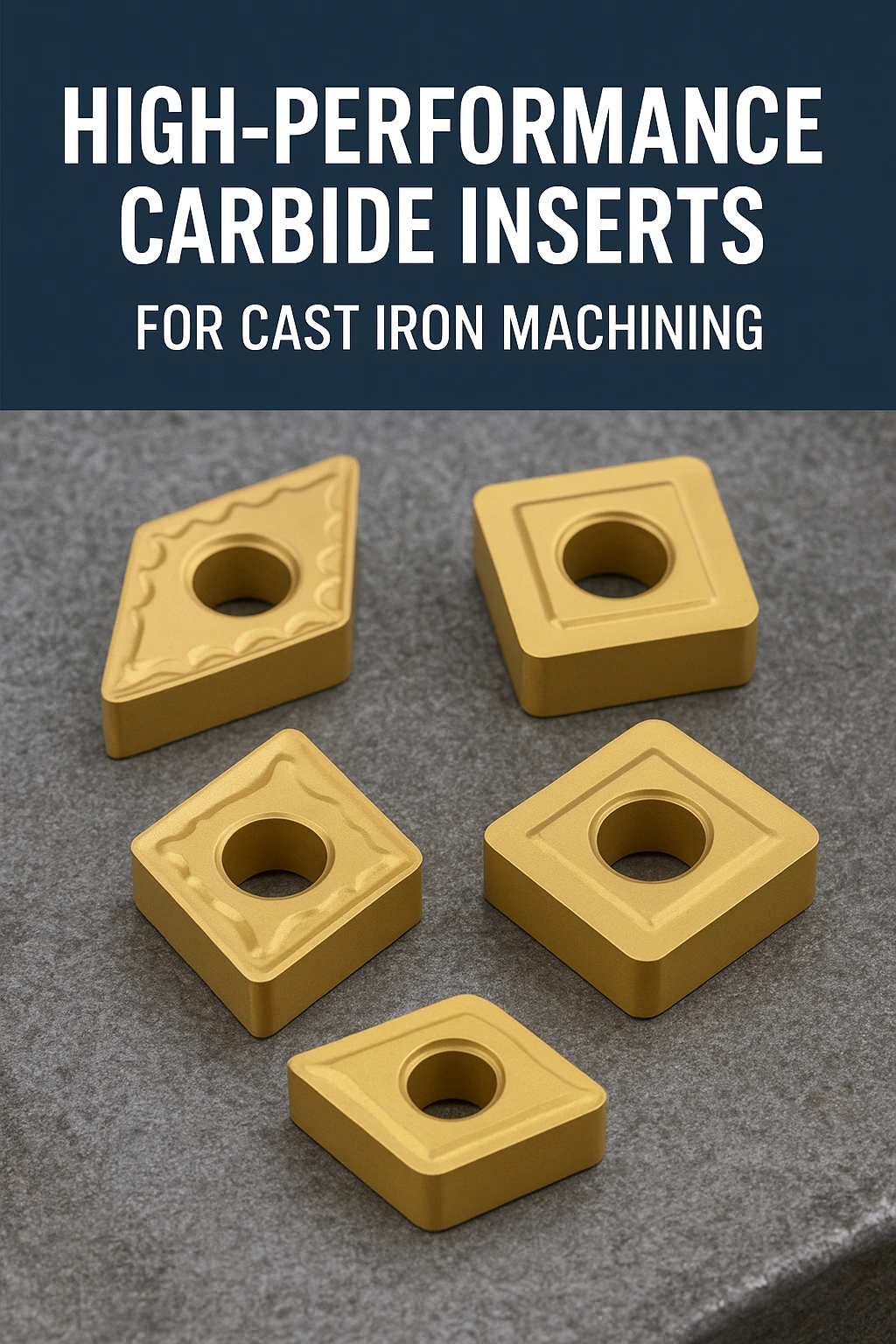
Machining cast iron requires carbide inserts designed to handle abrasive wear, graphite microstructures, and chip-breaking behavior. This expert guide from CNC Tools Depot explains how to select high-performance carbide inserts for cast iron machining, covering ISO 1832 insert nomenclature, chipbreaker geometry, and coating technologies (CVD, PVD, ceramic, and CBN).
With neutral comparisons across major brands like Sandvik, Kennametal, and Iscar, the article shows how to choose the right inserts for turning and milling operations in gray cast iron, ductile iron, and CGI. Practical shop-floor tips, a step-by-step selection checklist, and FAQs make this a complete reference for machinists, engineers, and buyers looking to maximize tool life, surface finish, and cost efficiency.
Overview
Why cast iron needs special carbide inserts
Cast iron (gray, ductile/nodular, compacted graphite, etc.) is one of the most commonly machined materials in industry — automotive brake rotors, pump housings, engine blocks and heavy machinery parts are all typical examples. Although cast iron is relatively “easy” to cut compared with some superalloys, it presents unique wear and chip-control behaviors (graphite in the microstructure, abrasive inclusions, self-breaking chips in many grades). Choosing the right carbide inserts, chipbreaker and coating is key to getting long tool life, good surface finish and predictable cycle times.
Cast iron types & machinability (short)
- Gray cast iron: contains lamellar graphite that tends to make chips break easily (self-breaking) and can act as a built-in lubricant; abrasive graphite causes flank wear.
- Ductile (nodular) cast iron: tougher — chips can be less self-breaking and can require chipbreaker consideration.
- Compacted Graphite Iron (CGI): in between gray and ductile — often used in modern engine blocks; machining behavior varies.
Each type affects chip shape, abrasive wear rate and optimal insert choice — manufacturers provide grade maps for “gray” vs “nodular/ductile” cast iron.
ISO 1832
ISO 1832 standardizes indexable-insert designations so you can buy consistent geometry across brands. Only the first 7 positions are commonly used for turning/milling inserts.
Example: CNMG120408 (common turning insert designation) — decode simply:
- C — shape: 80° rhombic (diamond).
- N — clearance/relief angle: 0° (neutral/negative relief).
- M — tolerance/manufacturer series indicator.
- G — ground/chipbreaker/clamping style modifier (manufacturer-specific).
- 12 — inscribed circle (IC) ≈ 12.7 mm.
- 04 — thickness ≈ 4.76 mm.
- 08 — nose radius 0.8 mm.
ISO 1832 is the authoritative reference for insert designation — use it to make sure “CNMG” from Supplier A is geometrically equivalent to Supplier B.
Why chipbreakers matter for cast iron
Cast iron often produces short, flaky chips (“self-breaking”), especially gray cast iron. That can be an advantage — it reduces the need for aggressive chipbreakers — but in higher feeds, interrupted cuts, or in ductile cast iron, you still need chip control. Proper chipbreaker selection improves surface finish, reduces jockeying of chips into the tool path, and lowers edge temperature.
Geometry rules of thumb
- Positive rake and sharp cutting edges often work well for finishing gray cast iron — they produce low cutting forces and good finish.
- Stronger/rounded edges (larger nose radii) help when machining nodular or CGI materials where toughness and intermittent cuts demand edge strength.
- Face-type chipbreakers or open chipbreakers are commonly chosen for cast iron milling to control brittle/segmented chips without causing re-cutting. Manufacturer chipbreaker maps are the practical tool to match feed/ap to chipbreaker.
Grade & coating
CVD vs PVD for cast iron (what to choose and why)
- CVD-coated carbide (thicker ceramic top layers such as Al₂O₃ over a TiCN base) gives excellent thermal and abrasive resistance — often the primary family for cast iron turning and milling where abrasion from graphite and inclusions dominates. Sandvik and other makers list CVD-coated carbide options for cast-iron machining.
- PVD-coated carbide is thinner and allows a sharper edge; works well for finishing or when you need a keen edge and lower cutting forces. It’s more common for steels but is used in many cast-iron finishing applications as well.
Ceramic & CBN
- SiAlON ceramics (and similar ceramic grades) are high-speed options for cast iron that offer long life under continuous cuts — Kennametal’s KYK10 ceramic is an example targeted at gray-cast-iron turning with higher speed capability. Ceramic grades give very long life in stable, continuous cuts but are brittle (so avoid heavy interruptions).
- CBN (cubic boron nitride) is used mainly for hardened materials; CBN isn’t the first choice for typical cast iron but can be used for specific grinding-like finishing or hardened cast materials.
Quick rule of thumb
- For most cast iron: start with CVD-coated carbide with an insert and chipbreaker designed for cast iron. For high-speed stable cuts, evaluate ceramic. Always follow manufacturer grade maps.
Milling vs turning inserts
Turning (CNMG, DNMG, SNMG, etc.):
- Use cast-iron-specific turning grades (CVD carbide or ceramic for high-speed) and chipbreakers intended for gray/ductile cast iron. For finishing, a sharper PVD-coated grade can be used.
Milling (square, round inserts, wiper geometries):
- Milling cast iron benefits from inserts with robust chipbreakers and positive rake to avoid fracture at the cutter-workpiece exit. Face-mills with cast-iron-optimized insert families (Kennametal Fix-Perfect series and others) can perform roughing and finishing with fewer operations.
Process tip: match the insert family to the machine rigidity, cutter diameter and coolant strategy; manufacturer pages show recommended vc, f and ap ranges for each grade.
Brand notes
- Sandvik Coromant publishes cast-iron-specific grade chains and clear guidance on when to use CVD vs PVD vs ceramic grades; they emphasize selecting grades based on thermal/abrasive load and stability. Their cast iron grade pages are a useful first reference.
- Kennametal provides specialized ceramic grades (e.g., KYK10) and milling systems tailored for cast iron; they also publish practical tools and chipbreaker maps.
- Iscar & others: many vendors supply cast-iron optimized chipbreakers and grades — use ISO 1832 to match geometry and then compare grade/coating charts for the specific application.
Frequently Asked Questions
For most cast iron work, CVD-coated carbide is a great starting point because it handles abrasion well. Use PVD if you need a sharper edge for finishing. Manufacturer grade maps will tell you which grades are intended for cast iron.
Use ceramics (SiAlON, etc.) for stable, continuous, high-speed machining of cast iron. They provide high wear resistance and speed capability but are brittle — avoid heavy interruptions. Kennametal’s KYK10 is an example of a ceramic grade for cast iron.
Gray cast iron often produces self-breaking chips due to graphite; still, chipbreakers help under higher feeds, milling, or with ductile grades. Check chipbreaker maps to match feeds.
Standardize by ISO 1832 geometry code (so the shape/size matches), then compare manufacturer grade names, recommended materials and feed/speed charts to find the best fit.

India's Largest Marketplace for Carbide Inserts & Cutting Tools.


© 2026. All Rights Reserved
Disclaimer: All Brand Logos belong to their respective owners, CNC Tools Depot is sharing publicly available information